

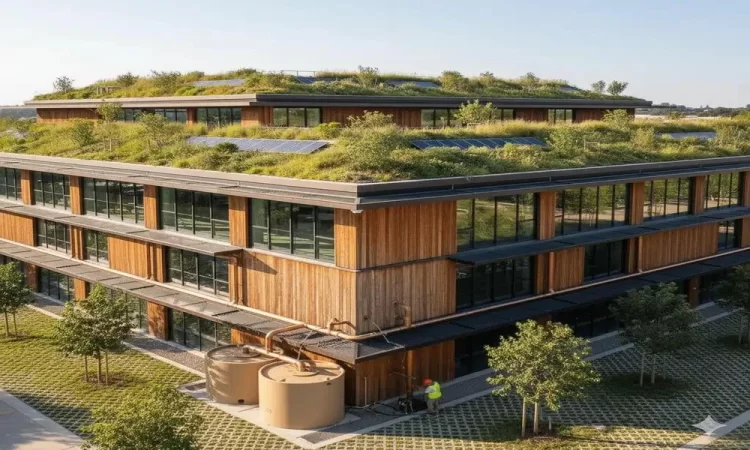
A sustainable building is not defined simply by solar panels on the roof or a collection of energy-efficient appliances. The strongest projects approach sustainability much earlier, during the stages when architects and engineers are deciding how the building will interact with its climate, occupants, materials, and surrounding environment.
This is why sustainable building design is increasingly focused on measurable building performance rather than individual green features.
Start With The Site, Not The Technology
One of the most overlooked aspects of sustainable design is the site itself.
A building’s location determines how much sunlight it receives, the direction of prevailing winds, exposure to heat, and opportunities for natural ventilation. Even the placement of neighboring structures can affect daylight and airflow.
For example, a building positioned to take advantage of prevailing breezes may reduce its dependence on mechanical cooling during suitable weather conditions. Strategic window placement and external shading can also reduce unwanted solar heat gain while maintaining access to natural daylight.
These decisions cost relatively little compared with installing new mechanical systems after construction. More importantly, they influence the performance of the entire building throughout its lifespan.
Design For The Local Climate
A building designed for a cool, dry environment should not necessarily use the same strategy as one located in a hot and humid region.
Climate-responsive design considers temperature, humidity, rainfall, solar exposure, and seasonal weather patterns. In warmer climates, designers may prioritize shading, reflective surfaces, ventilation, and efficient cooling. In colder environments, insulation, airtightness, passive solar gain, and heat recovery may become more important.
This means sustainability cannot be reduced to a universal checklist. A feature that improves performance in one location may provide limited benefits—or create new problems—in another.
Reduce Energy Demand Before Adding Renewable Energy
Renewable energy is valuable, but reducing energy demand should generally come first.
A poorly insulated building with excessive heat gain can require substantial energy for cooling. Installing a larger solar array may offset some of that consumption, but improving the building envelope could reduce the demand in the first place.
Designers can examine insulation levels, glazing specifications, shading, lighting, HVAC efficiency, and occupancy patterns to identify opportunities for reducing energy requirements.
The most effective approach is often a combination of passive strategies and efficient mechanical systems.
Consider The Building’S Entire Life Cycle
Sustainability does not end when construction is completed.
Materials eventually need maintenance, repair, replacement, or disposal. A material with a low initial environmental impact may not be the most sustainable choice if it has a short service life or requires intensive maintenance.
Life-cycle thinking therefore considers what happens throughout the building’s existence.
Designers can prioritize durable materials, adaptable floor plans, repairable components, efficient systems, and construction methods that minimize unnecessary waste. Designing a building that can accommodate changing uses can also reduce the likelihood of major renovations in the future.
Use Simulation Before Construction
Modern building projects can use digital modeling to investigate performance before physical construction begins.
Energy modeling can estimate heating and cooling requirements. Daylight analysis can examine how much natural light reaches occupied areas. Airflow simulation can reveal potential ventilation problems.
These tools allow design teams to compare alternatives instead of relying entirely on assumptions.
For example, changing the size or orientation of windows may affect both daylight availability and cooling demand. Simulation allows designers to evaluate those competing effects before committing to a final design.
The Goal Is A Building That Performs
The real test of sustainable building design is not how impressive a project appears on paper. It is how effectively the finished building performs over time.
For owners, that can mean lower operating costs and more predictable energy consumption. For occupants, it can mean improved thermal comfort, daylight, and indoor environmental quality. For the environment, it can mean reduced resource consumption and emissions.
The best sustainable buildings are therefore designed as systems rather than collections of features. By considering climate, orientation, materials, energy, water, occupants, and long-term maintenance from the beginning, project teams can create buildings that are more efficient, resilient, and practical to operate.